Pottery Rises to Level of an Art Form in Which Culture?
Neolithic artwork is part of Prehistoric art, not simply did it serve functional purposes, equally is and so characteristic of Prehistoric art, but it served aesthetic purposes too. Neolithic fine art is our visual record of the beginnings of civilization. This commodity will explore the question, "what is Neolithic art?"
Table of Contents
- 1 The New Rock Age: When Was the Neolithic Historic period?
- one.ane The Three-Age Arrangement
- 1.two The Neolithic Revolution
- ii What Is Neolithic Fine art?
- 2.ane Characteristics of Neolithic Artwork
- 3 Neolithic Artwork
- 3.one Çatalhöyük
- 3.2 Jericho
- 3.three Neolithic Megalithic Structures and Artwork
- 3.4 Neolithic Pottery and Ceramics
- iv From the New Rock Age to the Contemporary Age
- 5 Frequently Asked Questions
- five.1 When Was the Neolithic Flow?
- 5.2 What Is Neolithic Art?
- 5.3 What Are the Characteristics of Neolithic Fine art?
The New Rock Age: When Was the Neolithic Historic period?
Before we look at Neolithic art, a brief contextual background of the Neolithic period volition give us more understanding. The Neolithic age was the last function of the Stone Age, it was also referred to every bit the "New Rock Historic period". Information technology occurred, approximately, around ten 000 BCE to 3000 BCE.
The give-and-take "Neolithic" originates from the Greek words néos meaning "new" and líthos meaning "stone". The English scientist John Lubbock introduced the term "Neolithic" and "Palaeolithic" in the 1870s, the latter of which was the earlier part of the Rock Historic period, besides referred to equally the "Onetime Stone Age".
In-between the Neolithic and Palaeolithic eras was the Mesolithic Stone Historic period, meaning "Centre" Stone Age.
The Three-Age System
The Stone Age falls into the broader categorization of prehistoric times, and so permit us briefly zoom out and see where we are. The Iii-Age System, started in the xixth Century, was utilized as an archaeological dating tool to categorize prehistory into three respective periods, namely, the Rock Age (c. 2.vi 1000000 years ago to 3000 BCE), the Bronze Age (c. 3000 BCE to 1300 BCE), and the Iron Historic period (1300 BCE to 900 BCE).
This categorization made it easier for non merely archaeologists and scholars, only anyone who seeks to sympathize the history and evolution of man. Although there were other scholars that introduced a divisionary organization for prehistory, the Danish man Christian Jürgensen Thomsen, the Director of the Purple Museum of Nordic Antiquities, refined this method of classification.
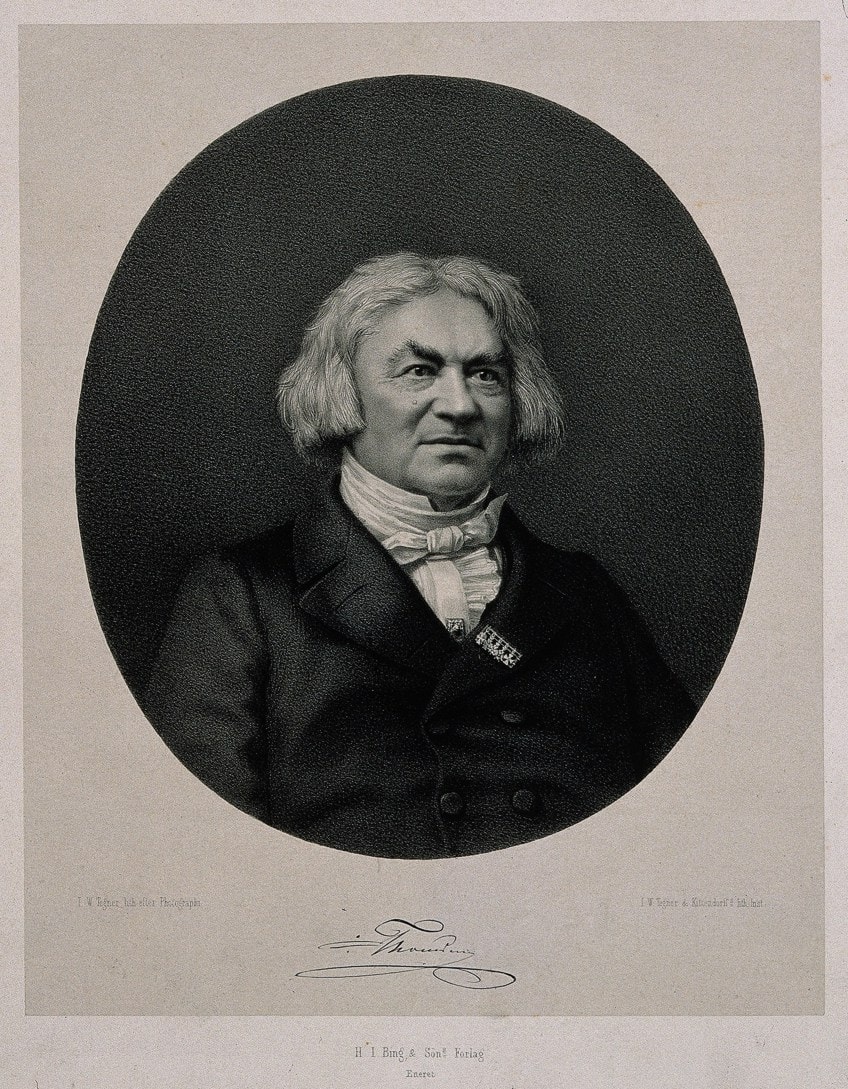 Portrait of Christian Jürgensen Thomsen (1788-1865);Run into page for author, CC Past 2.0, via Wikimedia Commons
He outlined this organization in 1837 in one of his essays, titled, Kortfattet Udsigt over Mindesmærker og Oldsager fra Nordens Fortid (1837) ("Brief Outlook on Monuments and Antiquities from the Nordic By"). This essay was function of a collection of volumes published past the Danish Purple Society for Ancient Nordic Manuscripts, this was titled, Ledetraad til Nordisk Oldkyndighed (1836) ("Guideline to Scandinavian Artifact").
Thomsen'due south method was pregnant because he categorized different materials from prehistoric times, namely, rock, bronze, and iron.
Additionally, these different periods existed in different parts of the earth. For example, some of the master Neolithic regions were Mesopotamia, the Levant, Northward Africa, Asia, and Western and Northern Europe, among others. The time periods also ranged betwixt regions.
The Neolithic Revolution
The Neolithic menses marked the beginnings of changes in civilization, this has been referred to equally the Neolithic Revolution. This term was introduced by the Australian archaeologist, Vere Gordon Childe in the early on 1900s. Childe's usage of the term "revolution" could accept perchance come up from the tenets of Marxism, which influenced him.
It is of import to notation that most of the changes during these prehistoric periods occurred gradually – it was not an overnight occurrence. The nomadic lifestyle was still prominent and with steady progression, farming increased, which led to settlements. Childe's concept of a "revolution" as well received critique from various archaeologists because information technology may have been "misleading".
 A curt animation of the chronology of the introduction of agriculture in Europe;Wikirictor, CC By-SA 4.0, via Wikimedia Commons
From the hunter-gatherer mode of living at that place were new developments in farming and agricultural modes of living. During the Palaeolithic period, people utilized stone and os tools, but these were basic in their course. Artwork existed during this menstruation, but it was too rudimentary, made from natural materials and pigments.
The Mesolithic menstruation slowly became more developed with polished tools too as the beginnings of agriculture and settlements. This then became the Neolithic period, where settlements were permanent, people farmed, grew grains, domesticated animals, and various home-based functions like weaving, pottery, and sewing. This certainly was a "revolutionary" type of menses in human development because it set the foundations for humans to settle and live in more permanent environments.
This type of living, compared to the nomadic lifestyle, inevitably inverse man behaviors and in turn, it affected all areas of life, including art and what information technology was made for.
What Is Neolithic Fine art?
Equally nosotros discussed to a higher place, the Neolithic flow barbarous somewhere between 10 000 BCE to 3000 BCE. It marked the starting time of numerous new developments in social and cultural life. In clarifying the Neolithic fine art definition, we volition talk over various related characteristics below.
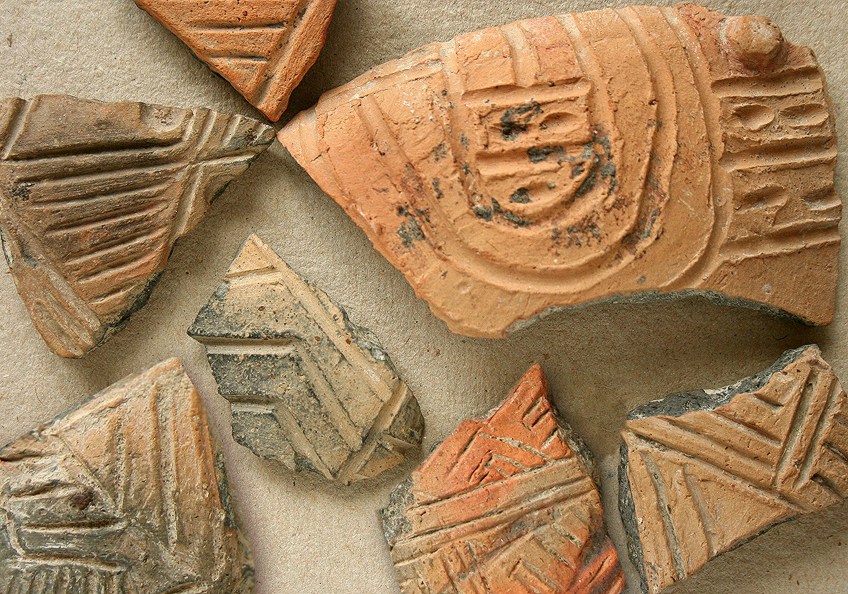 Geometrical scratched motive well-nigh Hodmezovasarhely, Hungary, Neolithic period;Takkk, CC BY-SA 3.0, via Wikimedia Commons
Characteristics of Neolithic Artwork
The characteristics we outline for Neolithic art are quite different from the blazon of characteristics nosotros outline for art movements like the Renaissance. Neolithic art, first and foremost, served several functions, either related to food, farming, ritual, decoration, or any other purpose related to Neolithic living.
Furthermore, Neolithic fine art was not a split aspect of the various Neolithic cultures, so we will also look at cultural characteristics, which inform the artwork.
The major changes that took place during this time were notably the increased security in terms of condom and food. With this came an increase in population and people settled in communion or "small tribes". This besides gave people the sense of place and territory, which inevitably increased the way they treated their surroundings, for example, living spaces, tools, objects, and each other.
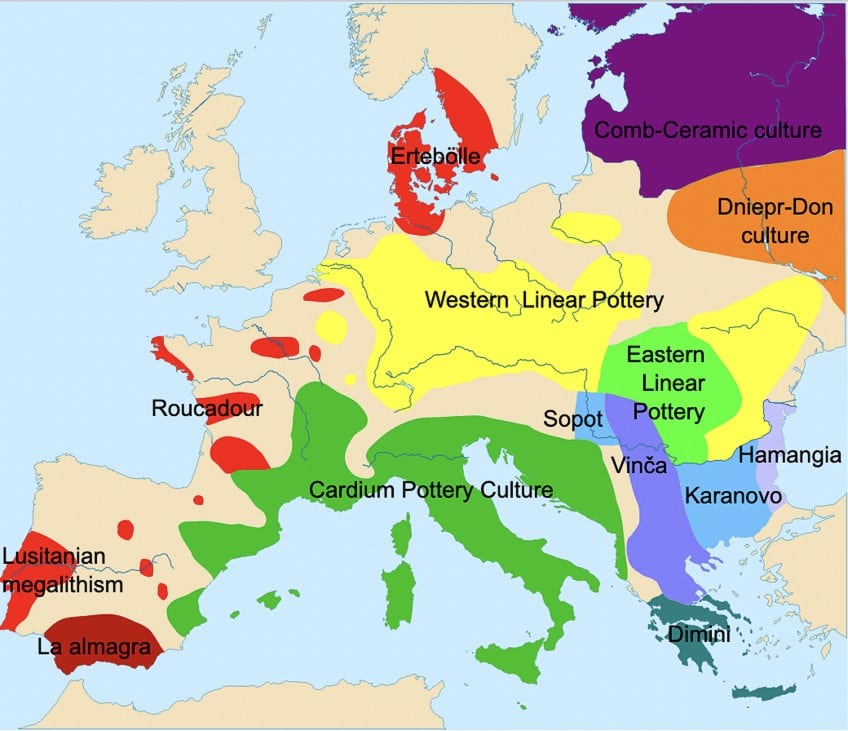
Map of the dissimilar cultures and settlements of the European Eye Neolithic menses; !Original: due west:Sugaar (talk | contribs);due west:Clarifer (talk | contribs)Vector: Joostik, CC BY-SA 3.0, via Wikimedia Commons
This follows on from how people treated one another, there was an increment in hierarchical structures. Food was besides usually maintained and stored on a more communal level instead of individually in households. Furthermore, there were also areas for rituals, which were plainly tied to the veneration of crops and climate changes.
There was a focus on the feminine and masculine qualities, and we will notice this in the Neolithic sculpture of female figurines throughout these periods.
Cults and shamanism were also a part of cultures and certain animals held more pregnant than others. The realm of organized religion and ritual during prehistoric times is complex, and it is important to note the vastness of it throughout the regions and the importance placed on different deities and conceptions of the divine.
Neolithic Artwork
Neolithic artwork consists mostly of pottery, terra cotta sculptures, statuettes, various smaller pieces that were utilized as adornments, Neolithic drawings like engravings and wall paintings, pictograms, and nearly notably megalithic structures – think Stonehenge (we will get to that). Neolithic sculpture was besides made through new techniques like sculpting it from clay and blistering it instead of just strictly through etching.
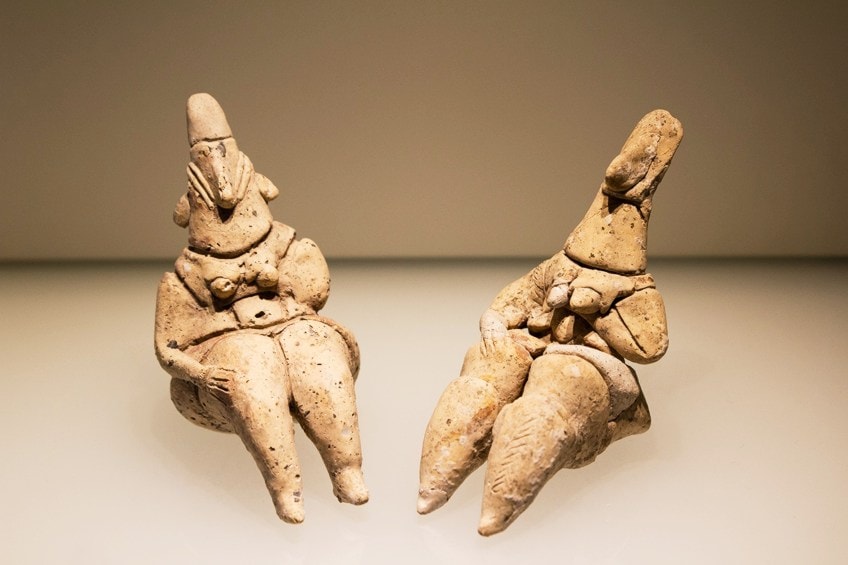 Neolithic Yarmoukian culture figurines at the Israel Museum in Jerusalem;Oren Rozen, CC BY-SA 4.0, via Wikimedia Commons
Below, we discuss some of the prominent artistic pieces, from pottery, skulls, to megalithic structures. We will likewise discuss important archaeological sites where extensive collections of artworks were institute, giving u.s.a. a visual indication of the role art played in the Neolithic communities.
Carry in mind that while this only touches on a select few examples of Neolithic artwork, in that location are meaning numbers of artwork excavated from this art period.
Çatalhöyük
Çatalhöyük is likewise referred to as Çatal Höyük and is an archaeological site in Turkey not far from one of the major cities named Konya. The site was accounted a UNESCO Earth Heritage Site in 2012. It is a site filled with evidence of not only hunter-gatherers but people who settled and lived in communities. It is reported that around 6000 to 8000 people inhabited these spaces thousands of years agone.
The site consists of various buildings made of mud bricks, these were congenital very closely next to i another, in fact, people moved around via the rooftops and entered their respective living spaces through holes or doors in the roof, some doors were also on the sides, by ways of ladders or stairs.
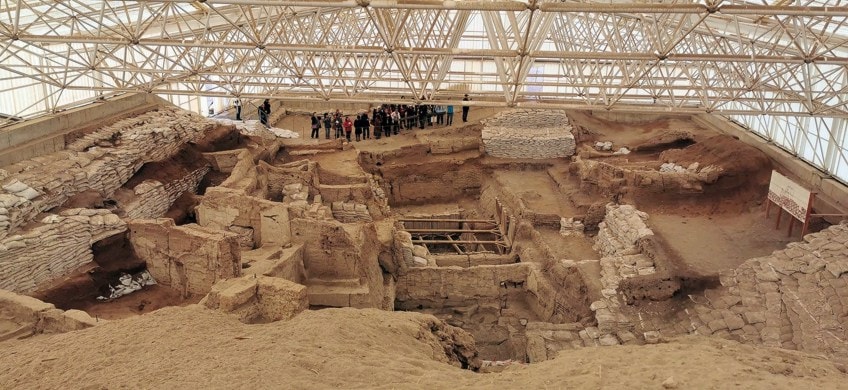 A very large Neolithic and Chalcolithic proto-city settlement in southern Anatolia, 7400 BC;Murat Özsoy 1958, CC By-SA 4.0, via Wikimedia Commons
The walls within the homes were usually plastered and rooms are reported to accept been kept in tidy conditions. Additionally, at that place were also up to two rooms in a dwelling with an extra room that could accept been utilized for storage purposes.
At that place has also been a various range of art discovered on this site, such as murals on walls inside and exterior homes.
The field of study matter for these murals was mostly geometric patterns and figural shapes. The figural shapes were often of animals with some homo-like forms incorporated. An example of this is titled the Neolithic Wall Painting in Edifice 80, Çatalhöyük, among many other such images.
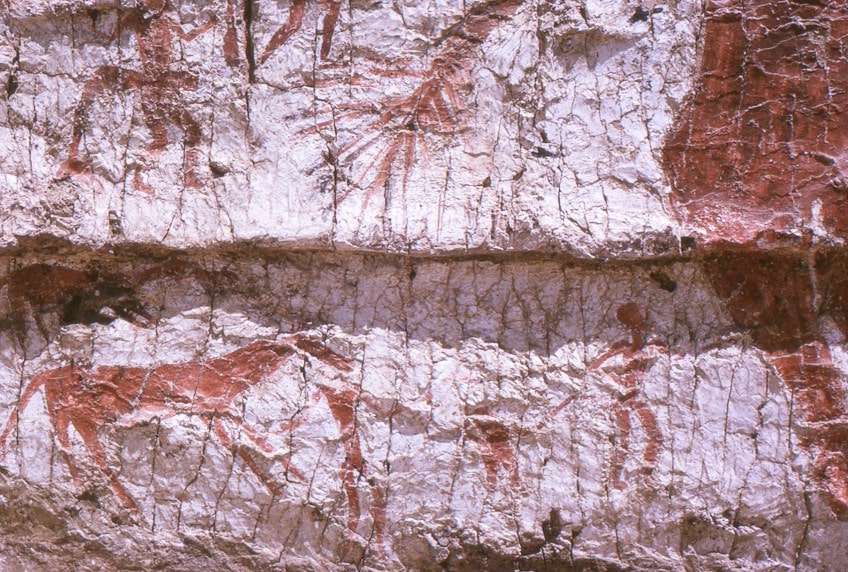 Detail of a Çatalhöyük landscape showing the hind part of the aurochs, a deer, and hunters;Omar hoftun, CC Past-SA iii.0, via Wikimedia Commons
Some examples of this include vultures at a dead corpse and what appears as ii cranes faced towards each other with a flim-flam behind them. A characteristic stance or depiction of these figures has been described as "splayed" considering nosotros volition often detect their heads not depicted or they would have no hands or anxiety.
Female dirt figurines accept also been plant on the site, for instance, the pop Seated Woman of Çatalhöyük (c. 6000 BCE). This depicts a female person sitting betwixt two feline figures, possibly ii armrests with the heads of feline figures. Some sources propose she may as well exist sitting on the feline figures. It is non clear what feline figures these are – it could possibly be leopards, lionesses, or panthers. The figurine is fabricated of baked clay and the right armrest and caput have also been restored.
The figurine is currently housed at the Museum of Anatolian Civilizations, located in Ankara metropolis, Turkey.
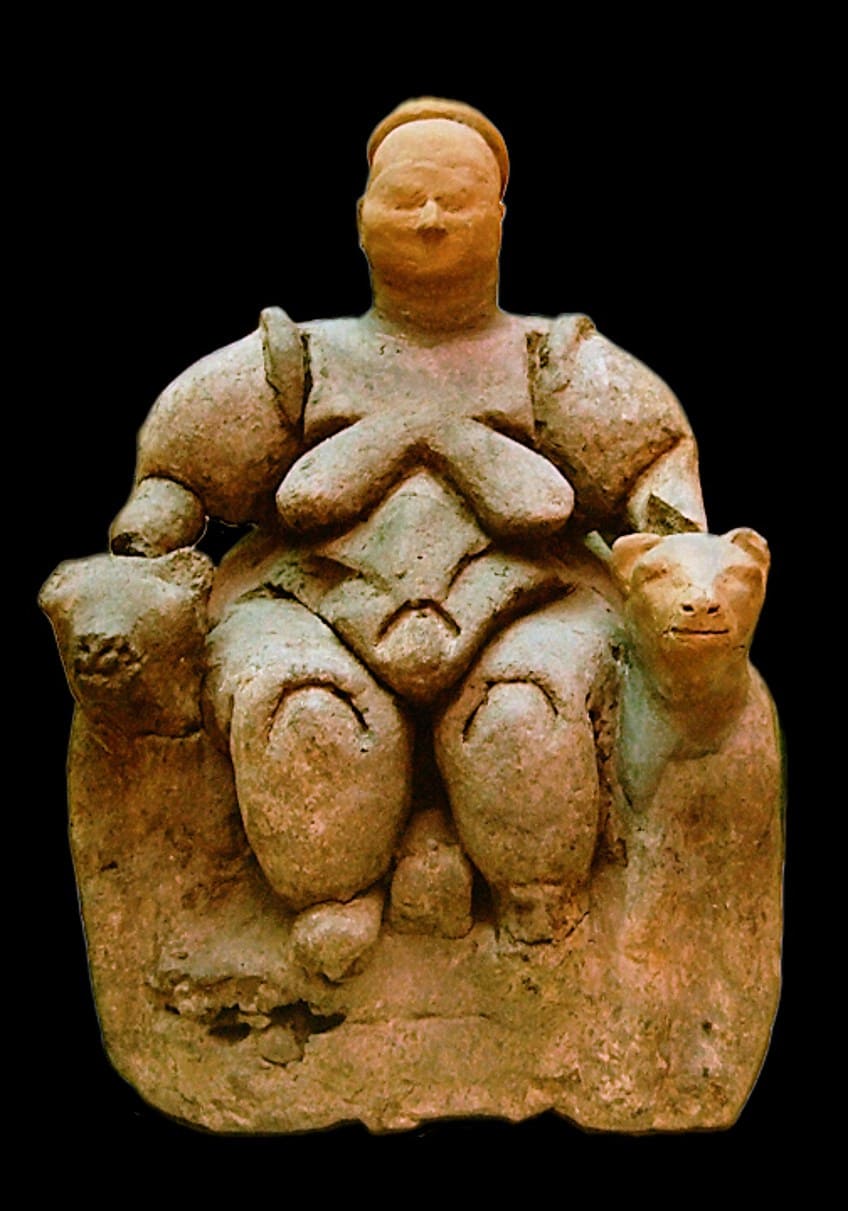 Seated Woman of Çatalhöyük, Museum of Anatolian Civilizations, Ankara, Turkey;User:Roweromaniak, CC BY-SA ii.5, via Wikimedia Commons
These female figurines were popular forms of Neolithic and connected to female person deities, however, there has been debate over the importance of the female person deities compared to male person deities, and sources also betoken out that both genders had equal standing. Furthermore, there take been effectually 2000 figurines excavated, predominantly consisting of animals.
The figurines were also constitute in different areas of homes, for example, some were found in garbage pits, others in walls or floors. The purpose of these figurines could exist for proficient luck or to keep bad spirits at bay. The to a higher place-mentioned Seated Woman of Çatalhöyük was excavated from a grain bin.
The excavator, James Mellaart, suggested that her purpose was related to expert harvests and the condom of food supplies.
Jericho
The Palestinian urban center, Jericho, is another site where the Jericho Skull (9000 to 6000 BC) and other similar skulls have been found. What is unique near these skulls is that they are plastered homo skulls. Many were males, however, at that place were besides females and children.
The skulls are believed to be connected to ritual and religious practices of burying the dead. When people died, they were buried under the floors and their skulls would ofttimes exist plastered with shells placed in the remaining middle sockets and sometimes man features like hair would exist painted on them.
 A plastered skull from the ancient city of Jericho in Palestine 7000 BC;Mary Harrsch, CC BY 2.0, via Wikimedia Commons
At that place are other sources that advise the skulls were for the "practice of headhunting" in which instance they would exist "trophies". Other suggestions indicate the skulls were to venerate the dead ancestors or to remember passed away loved ones by having an "prototype" of them (in this case, their skull) plastered and decorated to appear more than life-like. The skulls were plant at many other sites too, for example, Nahal Hemar, Tell Ramad, Beisamoun, Kfar Hahoresh, and others.
The verbal reason for these skulls is varied, simply from what the evidence suggests, these are early examples of what is believed to exist portraiture in art.
Neolithic Megalithic Structures and Artwork
As nosotros move on from the Neolithic sites mentioned in a higher place, nosotros movement into what is probably ane of the most fascinating aspects of Neolithic fine art: Neolithic megaliths. These are found in numerous regions of the world, and many are famously known in the regions of Europe like England and Ireland.
Stonehenge
Stonehenge (c. 2550 to 1600 BCE) is in England, on Salisbury Plainly, Wiltshire. It is one of the biggest prehistoric structures constructed, consisting of numerous large stones bundled in a circle; there is an outer circle and inner circle. The outer circumvolve consists of stones standing vertically each with a horizontal lintel stone. The rock is made from sarsen rock, which is a prevalent sandstone in England.
The stones stand around xiii feet tall, measure to around seven anxiety in width, and counterbalance over 20 tons each.
Inside this band are five sarsen trilithons (a trilithon is a construction consisting of two vertical stones next to the other with a horizontal rock on top of both), these appear in a horseshoe shape and weigh effectually l tons. We will also come across diverse Bluestones within the outer and inner circle of sarsen stones.
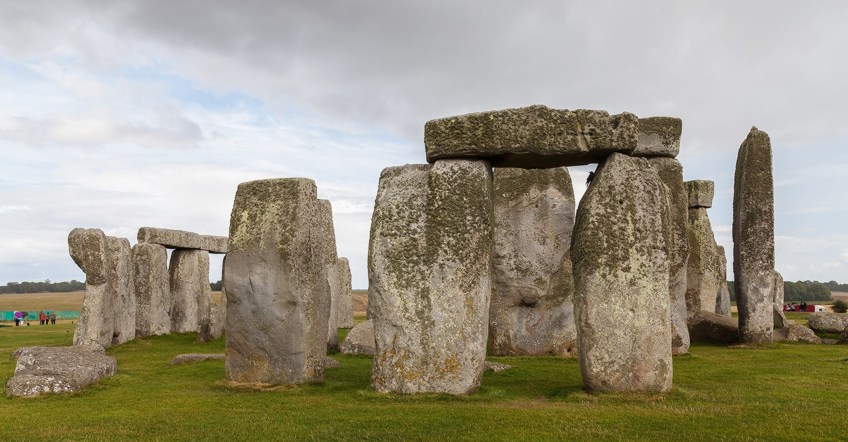 Stonehenge, Wiltshire, England; Diego Delso, CC BY-SA iv.0, via Wikimedia Commons
Stonehenge was reportedly built in three phases, although there is argue nigh the accuracy of when the phases took place. Stage One was around 3100 BCE, Phase Ii was around 3000 BCE, and Phase Three was around 2600 BCE, this was likewise the longest phase and lasted until around 2400 BCE.
This was a monumental undertaking and there is still a lot of fence about how this ancient structure was erected and by whom.
As to the function of Stonehenge, information technology peradventure served religious and ceremonial purposes. Its orientation is towards the sunrise on the Summertime Solstice, which gives a further indication for its purpose. It was declared a UNESCO World Heritage Site in 1986.
Avebury
There are too other stone monuments in the surrounding regions, for example, the Avebury monuments in Wiltshire, England. These are three stone circles located around the Avebury village. Information technology is too office of a henge, a bank with a ditch, surrounding the stones. The outer circle measures 1088 feet and the inner circumvolve of stone measures around 322 feet on the northern side and around 354 feet on the southern side.
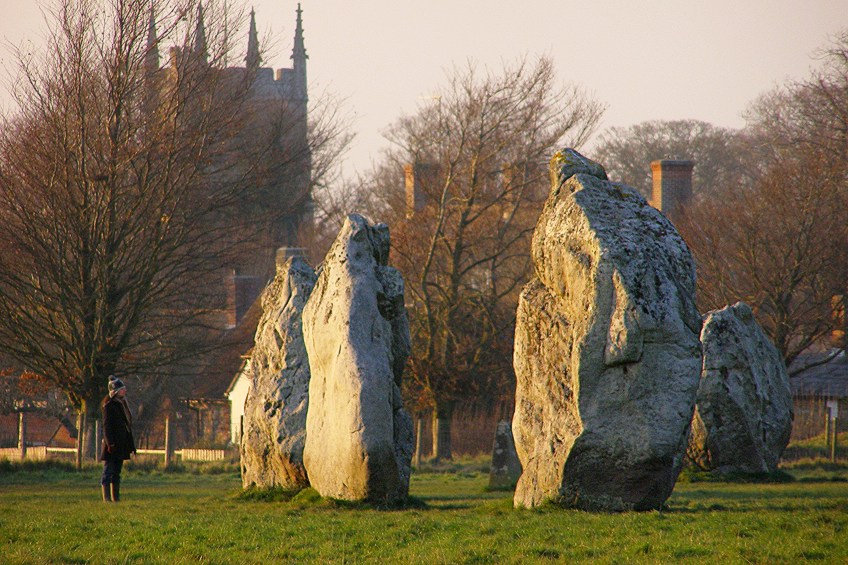 Avebury stones in the Due south Circumvolve viewed from the south-e quadrant bank. From left to right, stones 103, 102, 101, and 105 are shown. The pocket-size concrete mail marks the position of missing stone number 104. The tower of St James church building is in the groundwork;JimChampion, CC BY-SA iii.0, via Wikimedia Commons
It was congenital approximately around 2850 BCE to 2200 BCE. This is part of the associated World Heritage Sites, of which Stonehenge is a part. There is also a wide argue near the construction of Avebury besides every bit its purpose. Many scholars and non-scholars have posed ideas equally to this structure's purpose, some say it was most likely for ritual and ceremonial purposes.
Brú na Bóinne
Brú na Bóinne, meaning "Palace of the Boyne" or "Valley of the Boyne", is in the Canton Meath, Republic of ireland. Information technology is also referred to as the Boyne Valley Tombs. It includes the three major burial mounds or passage tombs, namely, Newgrange (c. 3300 to 2900), Knowth (c. 3200 BCE), and Dowth (between 3200 to 2900 BCE).
These are located nearly the River Boyne and are around twoscore to 50 kilometers n of the city of Dublin. The site was declared a UNESCO World Heritage site in 1993. The Brú na Bóinne complex is home to numerous Neolithic henges, stones, tomb chambers, mounds, and other structures related to anniversary and ritual.
An interesting fact about the Brú na Bóinne circuitous indicates that it was built before the Pyramids in Arab republic of egypt.
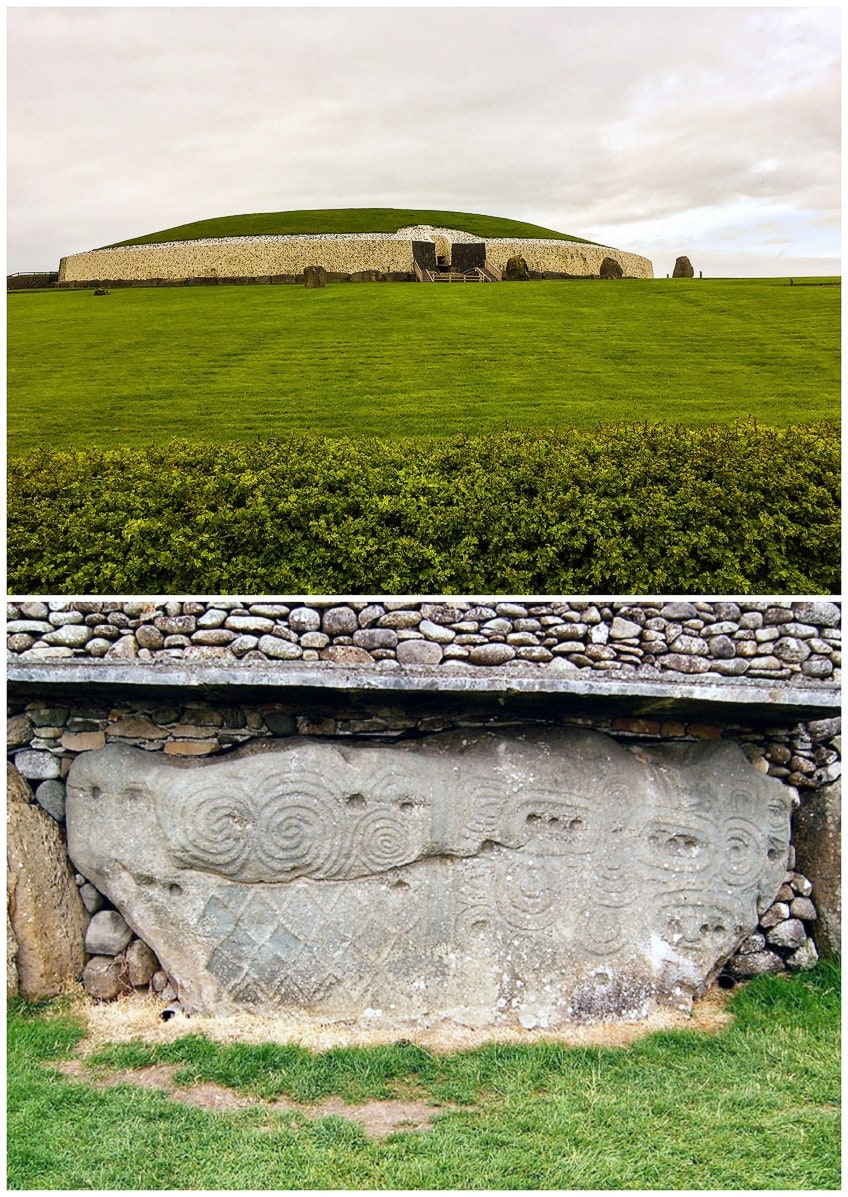 Height: The Neolithic passage tomb of Brú na Bóinne in Newgrange; Dieglop, CC Past-SA 4.0, via Wikimedia Commons | Lesser: A detail of one of the Neolithic borderstones of Brú na Bóinne, Newgrange; Pasztilla (régi), CC BY-SA 3.0, via Wikimedia Commons
We will also observe the extensive knowledge and application of astronomy, such as the Newgrange mound and its passage. The mound (measuring 249 feet broad, or across the structure, and 39 anxiety in height) was built with layers of stone and world with a passage leading effectually 60 feet into the central part inside the mount. The passage inside the bedroom is aligned when the lord's day rises in the Winter Solstice. The chamber inside is lit up for an estimated time of 17 minutes.
Some other important aspect of these mounds is their Neolithic stone fine art or rock engravings.
These are pregnant examples that tell us about the Neolithic catamenia art in Ireland. At that place are geometric motifs in distinct patterns, namely, spirals, circles, arc-like forms, chevrons, various lines like parallel lines, lozenges, and radials.
The triple spiral or "triskele" shape is among one of the mutual shapes nosotros run into on Irish megaliths. There is wide contend among scholars about the purpose of these designs, some say they are symbolic while others say they are decorative.
Neolithic Pottery and Ceramics
In that location were four periods that categorized Neolithic pottery and ceramic production in the Middle Eastward, in the Mesopotamia region. These were namely, the Hassuna period (c. 7000 to 6500 BCE), the Halaf period (c. 6500 to 5500 BCE), the Ubaid period (c. 5500 to 4000 BCE), and the Uruk flow (c. 4000 to 1300 BCE).
The Hassuna period was named afterwards the archaeological site chosen Tell Hassuna in Iraq.
Information technology was the site where the Neolithic Hassuna culture lived. The pottery from this site has been divided into three phases, namely, Hassuna Primitive, Hassuna Standard, and Samarran. The characteristics of pottery include creamy coloring with incised patterns.
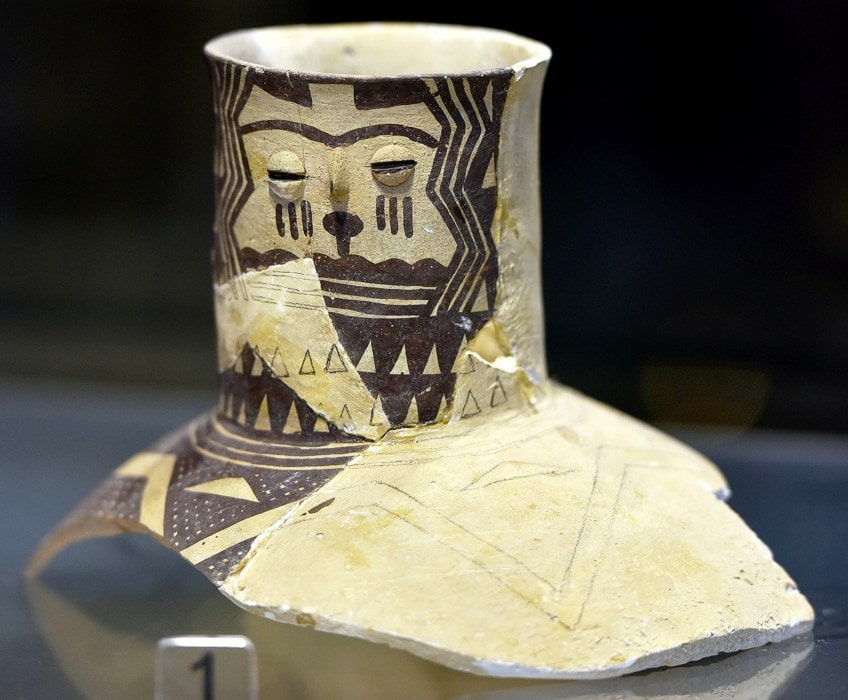 A pottery fragment showing the neck of a bottle-shaped jar painted with a adult female's face. The eyes and nose were added. The overall depiction points to Samarra civilisation from Tell Hassuna, 5000 BCE;Osama Shukir Muhammed Amin FRCP(Glasg), CC BY-SA iv.0, via Wikimedia Commons
The Halaf flow was named subsequently Tell Halaf in Syria. Characteristics of pottery included a wider range of colors with brute and geometric patterns. Halaf pottery has been considered quite technically advanced in its production.
When nosotros expect at the Ubaid flow, which is named afterward the archaeological site Tell al-'Ubaid located in Ur in Iraq. Pottery during this period also had creamy and brown colors with patterns that consisted of zig-zags, chevrons, and other geometric motifs. Pottery was too characterized every bit much plainer during this flow.
The last Uruk period that occurred was named after Uruk, a city in Sumeria.
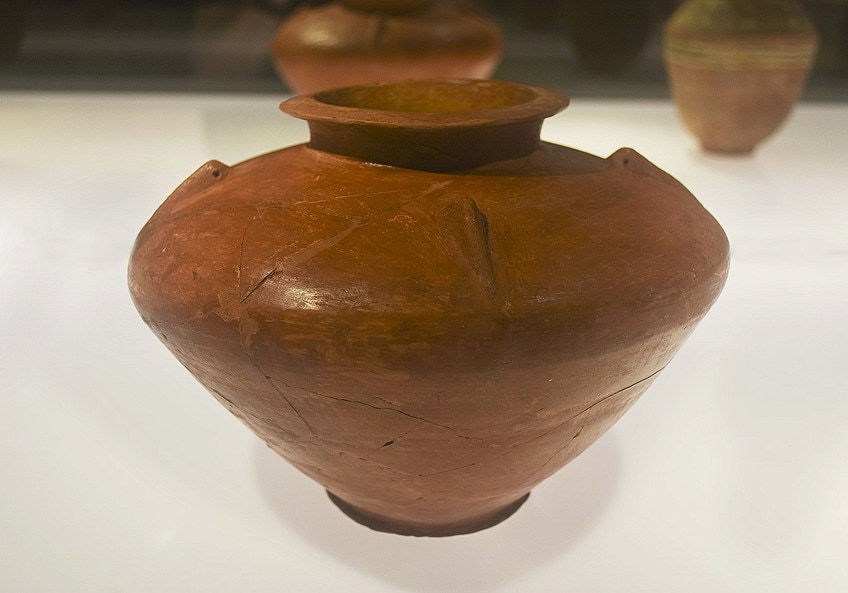 Pottery vessel from the late Susa Two period (Uruk Menstruum), 3300-3100 BC, Chogha Mish, Khuzestan Province, Iran;Jerónimo Roure Pérez, CC Past-SA 4.0, via Wikimedia Eatables
The potter'south cycle made information technology easier to produce pottery. Kilns were also enhanced. Pottery during this period appeared more than monochrome with bottom decorative motifs on the containers. If there were decorations these would announced as what is known equally "lozenge" motifs. In that location was too a big collection of pottery from this period in a range of shapes and sizes suited to different foods and needs. The various jars and vases had large bellies (bodies), shorter necks, and larger openings or mouths.
Neolithic pottery and ceramics in Red china were functional in nature and had various characteristics as the Neolithic menstruum progressed.
During the before Neolithic period, pottery was made from earthenware and fired generally in bonfires, and these were a red color. Pottery was as well hand-fabricated through the coiling method. Jugs were more prominent during the heart Neolithic flow in China, for example, the amphorae.
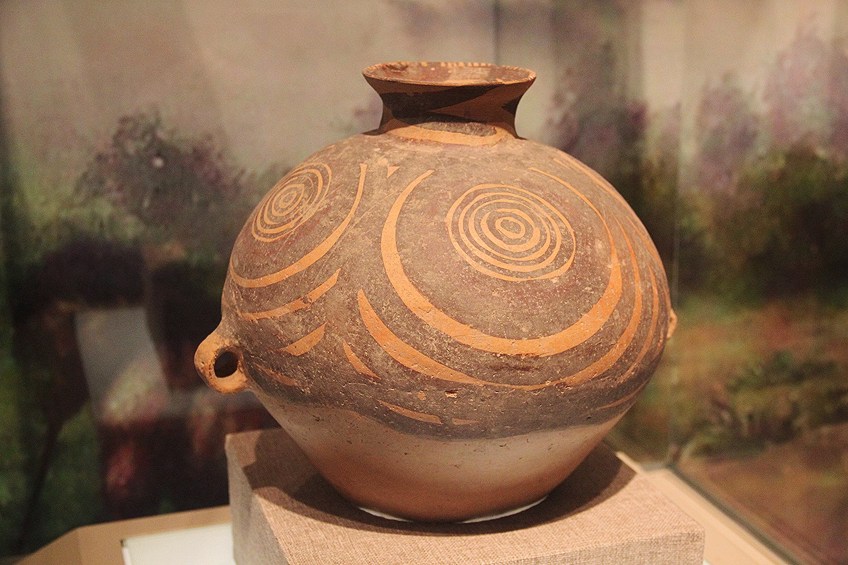 A typical example of Neolithic pottery in Prc, Xinyang City Museum, Henan Province; Gary Todd, CC0, via Wikimedia Commons
These were also red in colour and had diverse incised patterns. In other regions of Prc, some pottery was black in color due to it existence charcoal-tempered. The later Neolithic periods in China were increasingly glassy and decoratively painted with geometric patterns. There were many different Chinese cultures throughout the Neolithic menses and the production of pottery and sculpture developed in unique and complex means.
There were too various cultural and social factors that allowed this Neolithic fine art to evolve and become refined non but as a commonsensical object but as a class of craftsmanship.
From the New Rock Age to the Contemporary Historic period
The Neolithic or New Stone age evolved into the Bronze historic period, which started with the appearance of more than people using bronze. It started around 3300 BCE and lasted until around 1200 BCE. There was a wide range of artwork, not to mention all-encompassing statuary carvings, merely ceramics also developed more aesthetically. Records of the first blazon of writing accept been found from this age too.
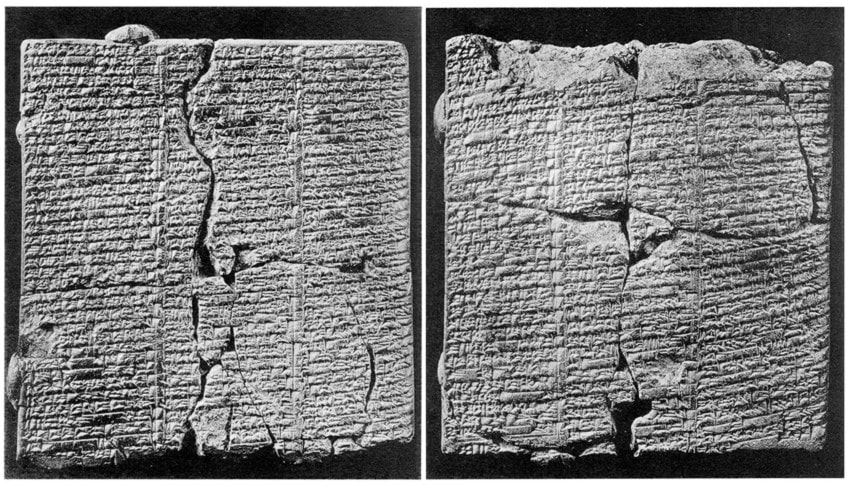 LEFT: Tablet of the Ballsy of Gilgamish (Obverse side); Stephen Langdon, Public domain, via Wikimedia Commons | RIGHT: Tablet of the Epic of Gilgamish (Reverse side); Stephen Langdon, Public domain, via Wikimedia Commons
Nosotros will also detect the Rock historic period revived in our contemporary age through various artists who replicate the enormity of Neolithic megaliths in everyday objects, for case, creative person Mark Leckey'south GreenScreenRefrigeratorAction (2010).
Other examples of or "throwbacks" to Neolithic times can be viewed in land art from the 1970s, for example, Nancy Holt'south installations called Lord's day Tunnels (1976). These structures, four concrete cylinders, were erected in Utah's Great Basin Desert and align with the Summertime and Wintertime Solstice's sunrise and sunset, reminiscent of the astronomical and ceremonial qualities nosotros see from the Neolithic period art.
The Neolithic menstruum was vast and complex, spanning across many regions, consisting of many peoples who all gradually evolved from the hunter-gatherer lifestyle to a more settled lifestyle including farming and agriculture, and animal domestication. We can about say the Neolithic historic period ready the phase for how nosotros alive today, in communities and settled environments.
Frequently Asked Questions
When Was the Neolithic Period?
The Neolithic age occurred, approximately, around 10 000 BCE to 3000 BCE. It was the last part of the Stone Historic period, otherwise the "New Stone Historic period". The word "Neolithic" originates from the Greek words néos meaning "new" and líthos meaning "stone". The Paleolithic age preceded the Neolithic age.
What Is Neolithic Art?
The Neolithic menstruum art varied in manner and subject field matter, information technology also occurred in numerous regions worldwide. It consisted of pottery, Neolithic sculpture, statuettes oft of female person and male figures, merely including animals too. There were also Neolithic drawings like engravings and wall paintings as well as rock fine art on various structures, most notably megalithic structures like Stonehenge or Newgrange. Neolithic pictographs were also common and many sources state that these could have been the precursors of writing.
What Are the Characteristics of Neolithic Art?
Neolithic fine art served different functions, these were either related to food, farming, ritual, decoration, or any other purpose related to the Neolithic lifestyle. Neolithic art was non a split office of Neolithic cultures, the two become together, for example, the way people live directly influenced the Neolithic art definition and its characteristics. The changes that took identify during this fourth dimension included increased security like personal safety and food. These changes resulted in increased populations, which gave people a sense of identify and territory, this likewise changed the way people treated their surround, for case, living spaces, tools, objects, and each other.
Source: https://artincontext.org/neolithic-art/
0 Response to "Pottery Rises to Level of an Art Form in Which Culture?"
Post a Comment