What if Dementia Runs on Bith Sides of My Family
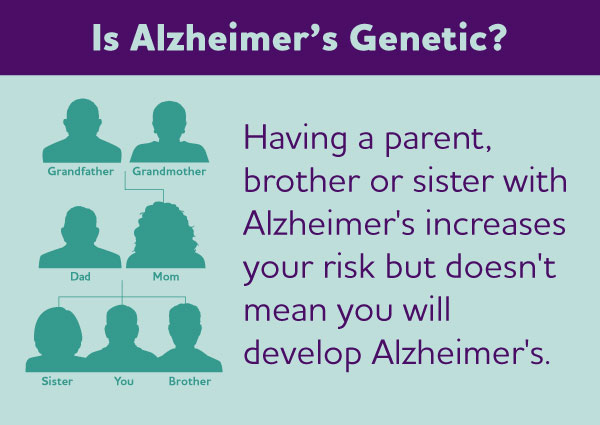 Family history is not necessary for an individual to develop Alzheimer'south. All the same, research shows that those who have a parent or sibling with Alzheimer's are more likely to develop the disease than those who do not have a first-caste relative with Alzheimer's. Those who have more than one first-degree relative with Alzheimer'south are at an even higher take chances. When diseases like Alzheimer's and other dementias tend to run in families, either genetics (hereditary factors), environmental factors — or both — may play a function.
- Genetics and Alzheimer's
- A closer look at genes linked to Alzheimer'due south
Genetics and Alzheimer'southward
There are two categories of genes that influence whether a person develops a disease: (1) take chances genes and (two) deterministic genes. Researchers have identified hereditary Alzheimer's genes in both categories.
- Risk genes increase the likelihood of developing a disease but do non guarantee information technology will happen. Researchers have found several genes that increment the chance of Alzheimer's. APOE-e4 is the first risk gene identified and remains the factor with strongest bear on on risk. Researchers estimate that betwixt xl-65% of people diagnosed with Alzheimer's have the APOE-e4 gene.
APOE-e4 is one of 3 common forms of the APOE gene; the others are APOE-e2 and APOE-e3. We all inherit a copy of some grade of APOE from each parent. Those who inherit ane copy of APOE-e4 from their mother or father accept an increased chance of developing Alzheimer's. Those who inherit two copies from their mother and father accept an fifty-fifty higher risk, merely not a certainty. In add-on to raising risk, APOE-e4 may tend to make symptoms appear at a younger age than usual.
An estimated twenty-thirty% of individuals in the United states have one or ii copies of APOE-e4; approximately 2% of the U.Southward. population has 2 copies of APOE-e4.
Genetic testing
Genetic tests are available for both APOE-e4 and the rare genes that directly crusade Alzheimer'south. However, health care professionals do not currently recommend routine genetic testing for Alzheimer's disease. Testing for APOE-e4 is sometimes included as a part of inquiry studies.
Download
- Deterministic genes directly cause a disease, guaranteeing that anyone who inherits one will develop a disorder. Scientists accept establish rare genes that cause Alzheimer's in only a few hundred extended families worldwide. These genes, which are estimated to business relationship for one% or less of Alzheimer's cases, crusade familial early-onset forms in which symptoms usually develop between a person's early on 40s and mid-50s. The vast bulk of individuals with Alzheimer's have late-onset disease, occurring at age 65 or afterwards.
Although the hereditary genes that crusade "familial Alzheimer'due south" are rare, their discovery has provided of import clues that assist our agreement of Alzheimer's. All of these genes touch on processing or production of beta-amyloid, the protein fragment that is the main component of plaques. Beta-amyloid is a prime number suspect in decline and death of brain cells. Aducanumab (Aduhelm™), a drug granted accelerated blessing by the FDA, is the offset therapy to demonstrate that removing amyloid from the brain is reasonably probable to reduce cognitive and functional decline in people living with early Alzheimer's. Several other amyloid-targeting therapies are likewise in evolution.
Two international investigations are nether way to gain further insight into Alzheimer's disease by studying individuals with deterministic Alzheimer'due south genes: (1) The Dominantly Inherited Alzheimer Network (DIAN), funded past the National Constitute on Aging (NIA), includes x flagship inquiry centers in the United States, the United Kingdom and Australia. (2) The Alzheimer'due south Prevention Initiative (API) focuses on an extended family in Antioquia, Colombia in South America. At v,000 members, this is the earth's largest family unit in which a gene that causes Alzheimer's has been identified. API collaborators include DIAN.
Genetic tests are available for both APOE-e4 and the rare genes that directly cause Alzheimer's. In improver, testing for APOE-e4 is sometimes included equally a part of research studies. The Alzheimer'southward Association does not recommend genetic testing for Alzheimer's illness for the full general population. If you lot are concerned about Alzheimer'southward affliction or memory changes in yourself or a loved one, the Association encourages you lot to have a frank conversation with your health care provider.
About at-home genetic tests
The Alzheimer's Clan suggests that y'all talk to a genetic advisor before deciding to accept an at-domicile test and, if you determine to get genetic testing for Alzheimer's, once more after y'all receive the results. The National Society of Genetic Counselors website provides a searchable directory to locate a advisor. With an unsupervised, at-dwelling exam, at that place is a real possibility of misunderstanding results, which could event in making misinformed decisions well-nigh your health. If y'all are already experiencing symptoms of cognitive decline, see a health intendance professional for a total evaluation.
23 Chromosome Pairs; 4 Alzheimer's Genes Identified:
Amyloid forerunner protein (APP),
discovered in 1987, is the outset factor with mutations found to cause an inherited course of Alzheimer'due south.
Presenilin-1 (PS-1),
identified in 1992, is the 2d gene with mutations found to cause inherited Alzheimer's. Variations in this gene are the virtually mutual cause of inherited Alzheimer's.
Presenilin-2 (PS-2),
discovered 1993, is the third gene with mutations found to crusade inherited Alzheimer's.
Apolipoprotein E-e4 (APOE4),
discovered in 1993, is the first gene variation plant to increment gamble of Alzheimer's and remains the risk cistron with the greatest known bear upon. Having this mutation, nevertheless, does not mean that a person will develop the disease.
A closer await at genes linked to Alzheimer's
The 23 human chromosome pairs incorporate all of the xxx,000 genes that lawmaking the biological blueprint for a human being. This interactive illustration highlights the chromosomes containing each of the three genes that crusade familial Alzheimer'due south and the gene with the greatest impact on Alzheimer'southward take chances.
Source: https://www.alz.org/alzheimers-dementia/what-is-alzheimers/causes-and-risk-factors/genetics
0 Response to "What if Dementia Runs on Bith Sides of My Family"
Post a Comment